

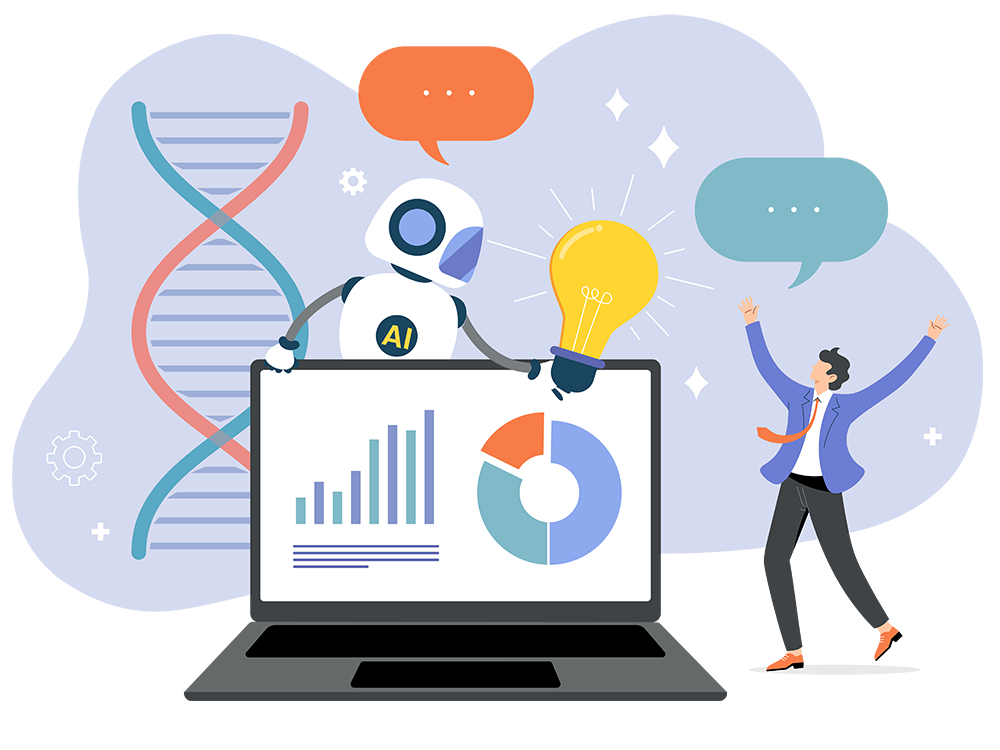
How AI is Reshaping
Organizational DNA
Decoding the digital transformation for modern business
Reshaping an organization’s “DNA” is the equivalent of gene-splicing the fundamental building blocks of how it operates—its structure, its decision-making logic, its processes and values. In 2026, AI is no longer just a discrete tool used in specialized departments; it is becoming the operating system of the entire enterprise. Here is how AI is fundamentally rewriting organizational DNA.
1. STRUCTURAL COLLAPSE:
(Flattening the Hierarchy)
Historically, organizational “genes” were built on a ladder: junior staff handled execution, middle management handled coordination, and executives handled strategy. AI is collapsing these distinctions:
- The “Hollow Middle”: Middle management roles are shrinking. AI now handles routine reporting, forecasting, and cross-departmental coordination—tasks that previously required layers of human oversight.
- Individual Empowerment: Junior employees (Individual Contributors) now act as “orchestrators.” With AI agents handling the grunt work of data mining and drafting, an entry-level analyst can perform high-level strategic analysis that once took a senior team weeks to produce.
- Cross-Functional Squads: Organizations are moving away from rigid functional silos (Marketing, IT, Finance) toward fluid, AI-powered “squads” built around specific products or customer journeys.
2. DECISION MAKING LOGIC:
From "Gut to "Agentic"
The core logic of how a business moves forward in today’s AI-focused business climate lies in shifting from human intuition to a hybrid model:
- Predictive Foresight: Instead of reacting to last quarter’s data, the organizational DNA is now “anticipatory.” AI models scan for anomalies in real-time—identifying supply chain disruptions or shifts in consumer sentiment before a human would notice.
- Agentic Workflows:
AI—systems that don’t just answer questions but execute multi-step tasks independently
- (e.g., an AI agent that identifies a budget shortfall, reallocates funds based on priority, and notifies the relevant stakeholders).
- Reduced Latency: The “speed of thought” is becoming the “speed of execution.” The gap between a strategic decision and its operational rollout is narrowing toward zero.
3. CULTURAL VALUES:
The "Human-Centric" Pivot
As AI takes over the cognitive load of “doing,” the value of human labor is being redefined. This creates a paradox in company work environments:
- The Rise of Soft Skills: In an AI-native company, “hard” skills (coding, data entry, basic writing) are basic, routinized, and commoditized. The premium focus on work products is shifting towards empathy, ethical judgment, and creative ambiguity.
- Digital Fluency as a Baseline: A “30% AI Mindset” is becoming a mandatory trait. Employees are expected to know not just how to use tools, but how to prompt, audit, and ethically steer AI outputs.
- Transparency and Trust: Because AI can be a “black box,” organizations are embedding Algorithmic Accountability into their values. Trust is no longer just about interpersonal relationships; it’s about trusting the data and the models that drive the business.
4. OPERATIONAL "GENE EDITING"
Following are some examples of how AI has fundamentally altered organizational DNA in three industries: retail, finance, and HR.
| INDUSTRY | OLD DNA | NEW AI-NATIVE DNA |
|---|---|---|
| Retail | Mass promotions & seasonal planning. | Hyper-personalized, real-time demand matching (e.g., Zara, Walmart). |
| Finance | Manual fraud audits and reactive CRM. | Real-time predictive mitigation and auto-correcting CRM (e.g., Barclays, PayPal). |
| HR | Resume screening & yearly reviews. | Real-time sentiment analysis and AI-driven “culture concierges.” |
THE RISK OF "DNA REJECTION"
AJust as a body might reject a gene edit, organizations face “brittleness” if they integrate AI too quickly, without changing their modes of thinking.Leaders must balance efficiency with “meaning”—if AI makes work feel less meaningful, then organizations need to compensate or they may see a drop in engagement, long-term innovation, and performance.
At Strategia Analytics, we literally “wrote the book” on Organizational DNA (Overholt, M.H., 1996). We’ve been helping organizations understand, manage, and align their DNA for over 30 years. Our proprietary DnA® Assessment reveals your “organizational DNA,” identifying relationships between your strategy and execution that can either enhance or impede successful performance. We offer key data-driven insights into various aspects of your workforce, including hiring/recruitment, retention, teaming and mission-focused behaviors. We provide options to choose from in initiating any necessary changes, and in partnership with you help determine which options will best serve to effectively manage
your DNA.
By strategically managing your DNA, you can establish a distinct and robust environment that attracts and retains the right talent, drives continuous improvement, and maximizes performance.
Are you implementing AI into your organization? There is no one better equipped to help you understand how that process is impacting your workforce. Need help aligning your organizational DNA?
Who ya gonna call?
Strategia.
For more information, please contact:
Dr. Miles Overholt
CEO and Founder, Strategia Analytics
moverholt@strategiaanalytics.com
888-992-8588